
Dubai Underground Metro Stations
Twelve Dubai Metro stations are underground out of 55, and they cluster where the network runs through the old city on both banks of Dubai Creek. Eight of them are on the Green Line, six on the Red Line, and two of those, Union and BurJuman, count on both because each has separate platforms for each line. Everything else on the network is elevated apart from Life Pharmacy, which sits at street level.
Every underground Dubai Metro station
The Red Line goes below ground for four stops through Deira and Bur Dubai, from City Centre Deira to BurJuman, then returns to a viaduct at ADCB and stays elevated for the rest of the run to Life Pharmacy. Two more Red Line stations are underground on the Route 2020 branch: Jumeirah Golf Estates and Dubai Investment Park.
The Green Line spends more of its length in tunnel. Salah Al Din, Union, Baniyas Square, Gold Souq, Al Ras, Al Ghubaiba, Sharaf DG and BurJuman are all below ground, eight of its 20 stations in an unbroken run through the densest part of the city.
Counted as platforms rather than buildings, the total is 14, because Union and BurJuman each have a Red Line level and a Green Line level. Counted as stations, it is 12. Either way the underground section is concentrated in a single stretch of the network, and no station south of BurJuman on the trunk goes below ground. The Green Line list shows the run in order.
| Code | Station | Line | Zone | Area |
|---|---|---|---|---|
| R16 | City Centre Deira | Red Line | Zone 5 | Port Saeed, Deira |
| R17 | Al Rigga | Red Line | Zone 5 | Al Rigga, Deira |
| R18 and G20 | Union | Red Line and Green Line | Zone 5 | Deira |
| R19 and G26 | BurJuman | Red Line and Green Line | Zone 6 | Bur Dubai |
| R73 | Jumeirah Golf Estates | Red Line | Zone 1 | Jumeirah Golf Estates |
| R74 | Dubai Investment Park | Red Line | Zone 1 | Dubai Investment Park |
| G19 | Salah Al Din | Green Line | Zone 5 | Deira |
| G21 | Baniyas Square | Green Line | Zone 5 | Deira |
| G22 | Gold Souq | Green Line | Zone 5 | Deira |
| G23 | Al Ras | Green Line | Zone 5 | Al Ras, Deira |
| G24 | Al Ghubaiba | Green Line | Zone 6 | Bur Dubai |
| G25 | Sharaf DG | Green Line | Zone 6 | Bur Dubai |
Structure and zones from the RTA rail network map published December 2025.
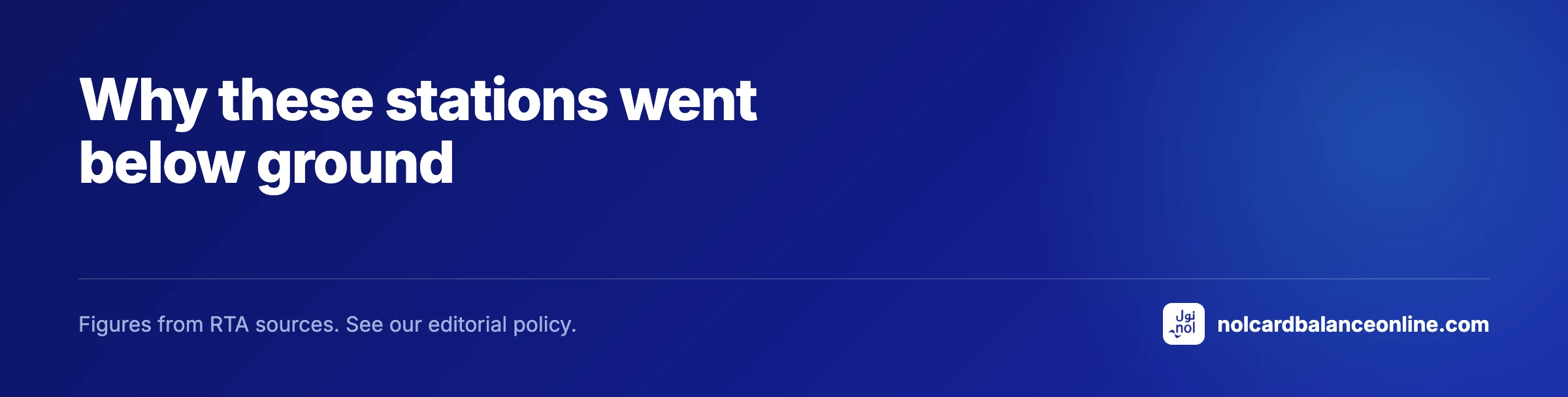
Why these stations went below ground
Space is the whole answer. Deira and Bur Dubai were built long before the metro and have no corridor wide enough for a viaduct: Baniyas Road, the souq streets around Al Ras and the blocks behind BurJuman are all tight, low rise and busy at street level. A tunnel was the only way through without demolishing large parts of the old city.
Sheikh Zayed Road faced the opposite problem and got the opposite answer. It is wide, already elevated in places, and lined with towers set back from the road, so the metro runs above it on a viaduct with stations reached by footbridge. That is why the stretch from ADCB to Ibn Battuta, 15 stations of it, never dips below ground.
The two branch tunnels have a different reason again. Jumeirah Golf Estates and Dubai Investment Park sit under developed land where a viaduct would have cut across plots and roads that were already laid out when Route 2020 was designed. The full Red Line list shows where the branch splits from the trunk.
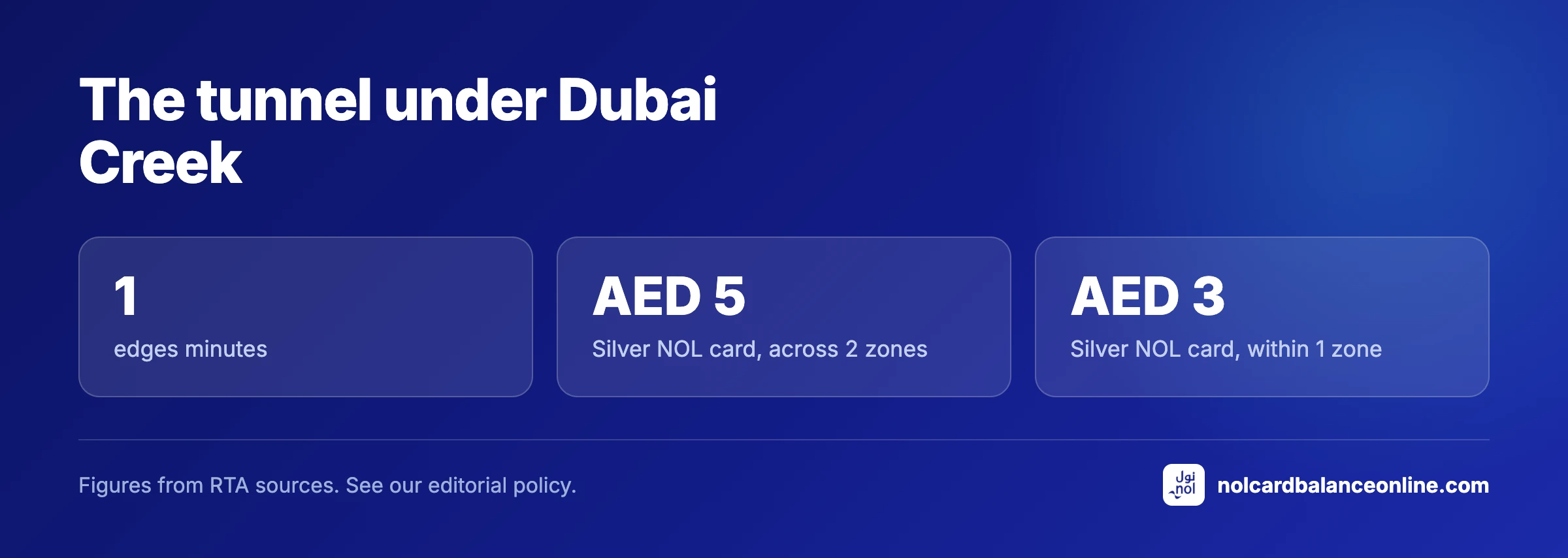
The tunnel under Dubai Creek
The Green Line crosses beneath the creek between Al Ras on the Deira side and Al Ghubaiba on the Bur Dubai side. That hop takes 1 minute, the shortest gap anywhere on the network, and it is the only point where the metro passes under water.
It is also a fare boundary. The creek separates Zone 5 from Zone 6, so that one minute ride costs AED 5 on a Silver card rather than AED 3. The Red Line crosses the same boundary underground one stop further east, between Union and BurJuman, for the same reason and the same price.
An abra across the same stretch of water costs a fraction of the metro fare and takes a few minutes. The zone system explains why two stations that are a minute apart can sit in different fare tiers.
Both crossings were built as bored tunnels beneath the creek bed, and the Green Line pair of stations either side of it, Al Ras and Al Ghubaiba, are among the deepest on the network. That depth is why the one minute ride between them can turn into a ten minute trip once you add the escalators at each end.
What underground means for a rider in August
Underground stations are cooled from the platform all the way to the street exit, which is a real difference between May and September. An elevated station puts you on a bridge and then a staircase, and even with cooled walkways there is usually a stretch of open air at the end of it. A below ground station does not.
The tradeoff is depth. Al Ras, Gold Souq and Baniyas Square have long escalator runs and a single set of exits each, so coming up at the wrong end of the platform adds a few minutes. Union and BurJuman are deeper still, with the Red and Green platforms on different levels, which is what makes a change there feel longer than the distance suggests.
Al Ghubaiba is the useful exception. It links directly towards the bus terminal and the marine station above it, so a metro to abra or metro to bus connection there stays under cover for most of the walk. Al Jadaf on the elevated section has a marine station alongside as well, though that one leaves you outdoors.
The elevated network above ground
Of the 55 metro stations, 42 are elevated, 12 are underground and one, Life Pharmacy at the southern end of the Red Line, sits at street level. All 11 Dubai Tram stops run at street level too, sharing the road through the Marina and Al Sufouh.
The elevated stations are the ones with the views: the run past Burj Khalifa and Dubai Mall, the sweep along the Marina at Sobha Realty and DMCC, and the stretch out to Ibn Battuta. They are also the ones where a footbridge stands between you and the destination, so the walk from platform to door can be longer than the map suggests. The full station list marks the structure of each one.
Structure is worth checking before a summer trip in a way it never is in January. A station listed as elevated means a footbridge, a staircase and usually a short walk in the open at the far end; underground means cooled air until the last few steps. For a family with a pram or a visitor arriving with luggage, that difference decides which station to aim for more often than the fare does.
Underground is not always the better station
Depth costs time. The climb from a Green Line platform at Al Ras to the street can take longer than the ride from the previous station, and there is no shortcut when a single bank of escalators is carrying a crowd off a full train. If you are moving between two elevated stations on Sheikh Zayed Road, the trip is often quicker door to door despite the heat.
The underground stations also carry the heaviest crowds. BurJuman took 17.8 million riders in 2025, Al Rigga 13.8 million and Union 13.6 million, the three busiest on the network and all below ground. Cool air is little comfort on a platform where you have to let two trains go at 18:00.
Keep reading
NOL Card Balance Check Online 2026: RTA Dubai
Check your NOL card balance with the 10 digit tag ID, then open the official RTA page. Minimum balance AED 7.50, every method, updated August 2026.
NOL Fare Calculator 2026: Dubai Metro, Bus, Tram
Work out any Dubai Metro, bus or tram fare by zone and card type: Silver AED 3 to 7.50, Gold double, Red Ticket, concessions. Updated August 2026.
NOL Card and Dubai Metro Questions and Answers
Straight answers on NOL balance checks, tag IDs, fares, zones, passes, refunds, lost cards, expiry and how our calculators are tested against RTA.
Frequently asked questions
How many Dubai Metro stations are underground?
Twelve of the 55. Six are on the Red Line and eight on the Green Line, with Union and BurJuman counted on both because each has separate platforms for each line. Every other station is elevated apart from Life Pharmacy at street level.
Which Red Line stations are underground?
City Centre Deira, Al Rigga, Union and BurJuman on the trunk, plus Jumeirah Golf Estates and Dubai Investment Park on the Route 2020 branch. The line runs on a viaduct everywhere else, including the whole of Sheikh Zayed Road.
Which Green Line stations are underground?
Salah Al Din, Union, Baniyas Square, Gold Souq, Al Ras, Al Ghubaiba, Sharaf DG and BurJuman, an unbroken run of eight through Deira and Bur Dubai. That is 8 of the line's 20 stations.
Does the Dubai Metro go under the creek?
Yes, twice. The Green Line crosses between Al Ras and Al Ghubaiba in 1 minute, and the Red Line crosses between Union and BurJuman in 3 minutes. Both crossings move you from Zone 5 to Zone 6, so the fare is AED 5.
Why is most of the Dubai Metro elevated?
Sheikh Zayed Road and the newer districts had room for a viaduct, which is cheaper and faster to build than tunnelling. Tunnels were used only where the city was too dense to build above the street, which is Deira, Bur Dubai and two spots on the Route 2020 branch.
Are underground stations cooler in summer?
Yes, they are cooled from the platform to the street exit with no open air stretch. Elevated stations rely on cooled footbridges, which still leave a short outdoor walk at most destinations.