
How to Use a NOL Card in Dubai
How to use a NOL card comes down to four moves: buy it, load it, tap in and tap out. The fare comes off the chip when you tap out, AED 3 inside one zone and AED 7.50 across more than two on a Silver card. A metro gate will not open at all below AED 7.50, so the balance matters more than the ticket.
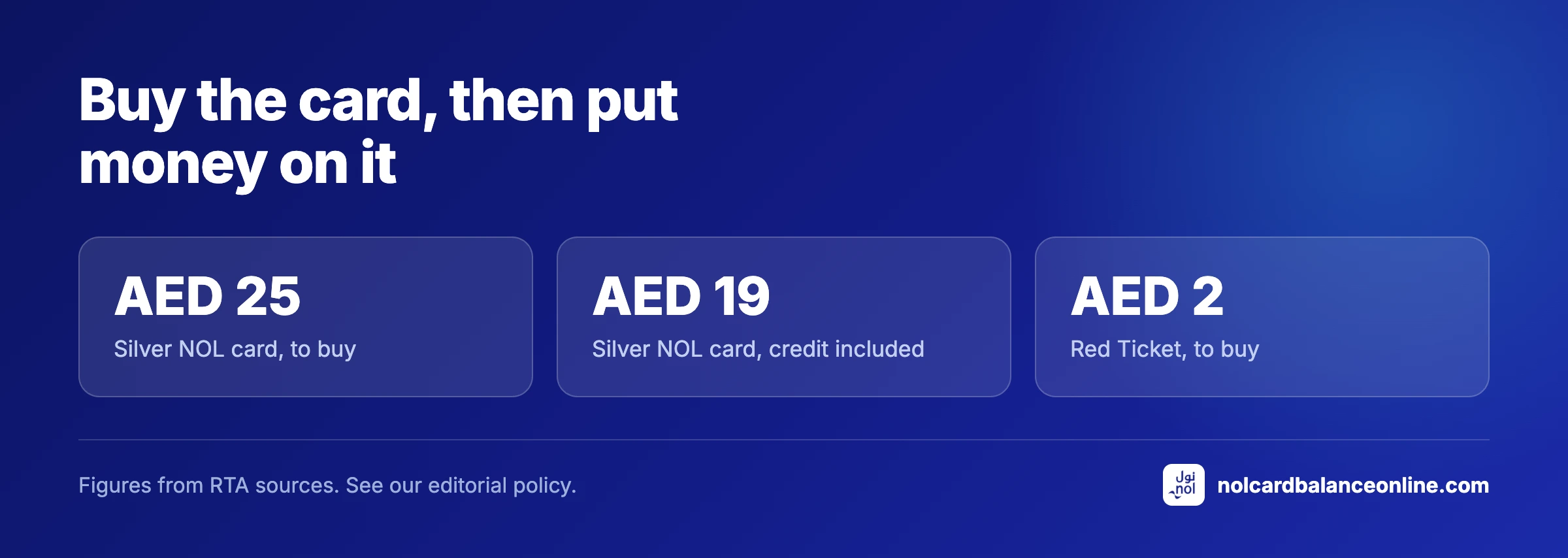
Buy the card, then put money on it
A Silver card costs AED 25 at a ticket office, a vending machine or an authorised retailer, and AED 19 of that is credit you can spend immediately. A Red Ticket at AED 2 carries no credit at all and holds a maximum of 10 single trips, which is why it suits a short visit rather than a commute. The five card types and who each one suits are compared here.
The second step is the one people underestimate. A metro ticket machine takes AED 20 or more and writes the credit during the transaction, so it is the only route that helps when you are already at the station. Anything paid online by tag ID waits 45 minutes to 4 hours and then loads on your next tap, which is no use at a closed gate.
Keep enough on the card to clear the AED 7.50 entry threshold plus the fare itself. A Blue card is the exception and opens a gate from AED 3.50, which is also how a Blue card ends a journey in the negative. A Red Ticket needs at least one trip loaded before it will let you through a gate at all. The same tap works on the Green Line under Dubai Creek, on the tram through JBR and Dubai Marina, and on the feeder buses of Al Qusais and Al Barsha.
Tap in and tap out on metro and tram
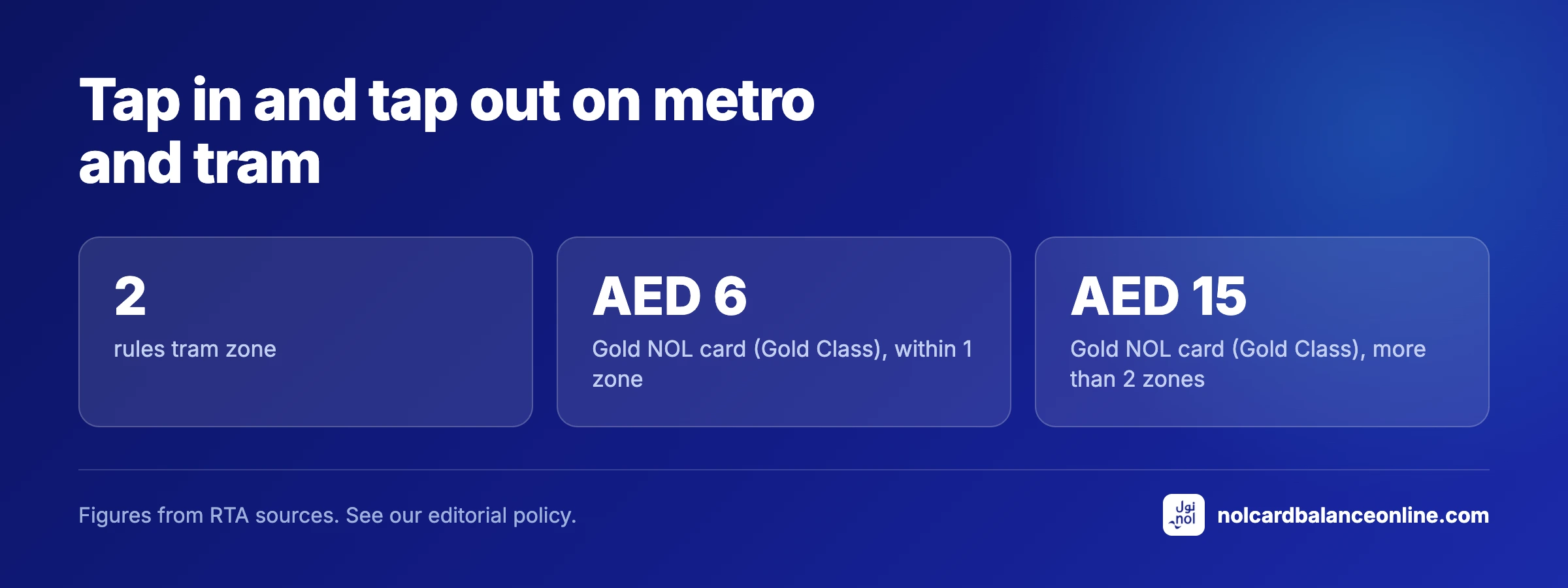
At a metro station, hold the card flat on the reader at the gate until the barrier opens and the small screen shows the balance left. That tap is your check in and it records the station you started from. At the far end, tap the same card on the gate to check out, and the system works out how many fare zones the trip touched and deducts the fare then.
The tram has no barriers, so the discipline is on you. Tap the validator on the platform before boarding and tap it again after you step off. A tram trip is priced as a single zone journey because every tram station sits in Zone 2, but a missed tap still leaves the journey open.
A Gold card taps the same gates and pays double for the privilege of the front cabin, AED 6 for one zone up to AED 15 across more than two. That premium applies on metro and tram only, so a Gold card riding a bus is charged the Silver fare.
The card holds no ticket and no route. It records a check in, a check out and the balance, which is why the zone your station sits in decides the price rather than the distance you rode.
Buses, transfers and what one journey costs
Buses use the same two taps. Tap the validator by the driver as you board and tap the one by the door as you leave, because a bus trip is priced by zone in the same table as the metro. Route 110 to the airport is the flat fare exception at AED 2 and travel passes are not valid on it. Feeder buses to metro stations follow the same rule and are charged as part of the journey when you transfer in time.
Change from bus to metro or tram inside 30 minutes of tapping out and RTA counts the legs as one journey rather than two fares. You get up to 3 transfers and the whole trip has to finish within 180 minutes. The fare is then charged once, for the total number of zones the journey touched.
There is also a daily ceiling of AED 20 on a Silver or Blue card and AED 40 on Gold, last published by RTA in its 2014 tariff revision and absent from the current fares page, so treat it as a guide. Our fare calculator prices any pair of stations and applies the transfer rule for you.
| Journey | Silver or Blue | Gold | Red Ticket |
|---|---|---|---|
| Within 1 zone | AED 3 | AED 6 | AED 4 |
| 2 adjacent zones | AED 5 | AED 10 | AED 6 |
| More than 2 zones | AED 7.50 | AED 15 | AED 8.50 |
| Student or senior (Blue) | AED 1.50 to AED 3.75 | n/a | n/a |
Based on RTA nol Fares. Gold pays the Silver fare on buses.
Where else the card pays
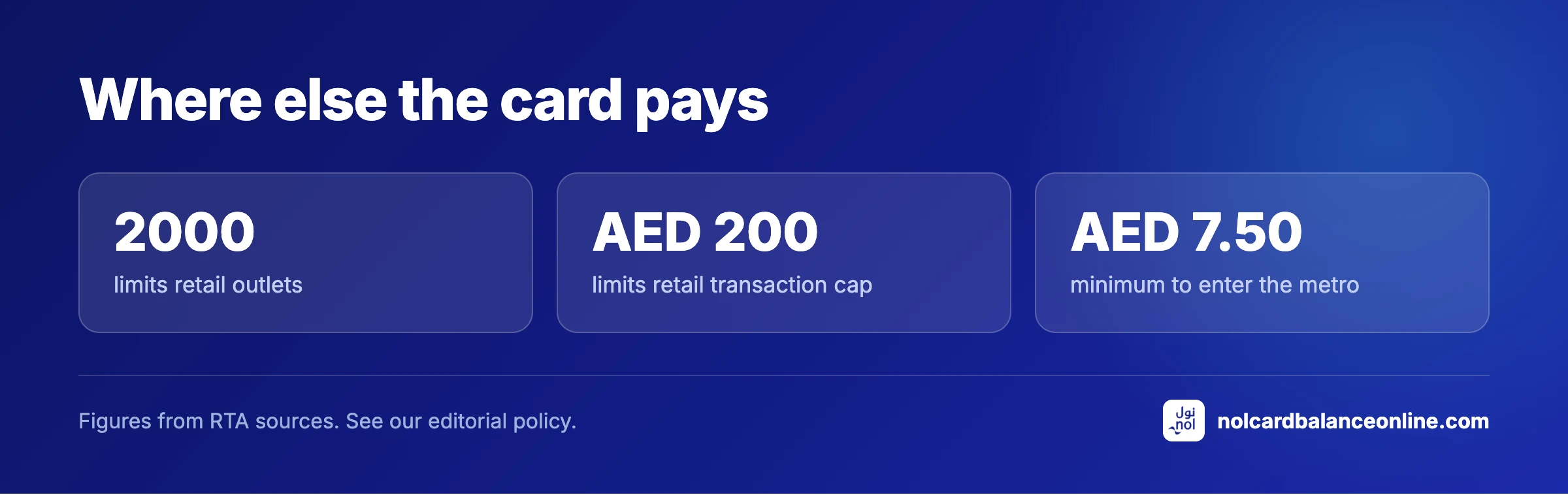
A NOL card is not only a metro ticket. The same card pays at public parking meters, on water buses, ferries and abras, and at roughly 2,000 retail outlets for small purchases, with a cap of AED 200 on any single retail transaction.
Those payments come out of the same balance as your fares, which is the trap. A coffee bought with the card in the morning can leave you under the AED 7.50 needed to enter a station that evening. Check the figure at the gate display, in the NOL Pay app or through any of the twelve top up channels before it becomes a problem.
Metro parking is the other place the card earns its keep. RTA parking at stations such as Centrepoint and Life Pharmacy is free within the posted limit, and an overstay runs at AED 100 a day, charged against the plate rather than the card.
The mistakes that cost money
RTA inspectors check cards on trains, trams and buses. Travel with no valid fare and the fine is AED 200, the same amount for using someone else's card or a card past its expiry date. A counterfeit card is AED 500.
The smaller fines catch tourists more often than commuters. A snack on the platform costs AED 100, and so does sitting in the Women and Children cabin or in Gold Class without the right card. Children aged 5 or under travel free and need no card at all.
Two rules apply to families. A child under 8 cannot travel alone, a child aged 8 to 11 needs a parental permit, and from 12 a passenger travels on their own card. Luggage is capped at one large piece of 81 × 58 × 30 cm plus one small piece per passenger.
A card that will not open a gate is usually a balance or an expiry problem rather than a broken chip. The common gate errors and their fixes are listed here.
| Offence | Fine |
|---|---|
| Travelling without a valid fare or nol card | AED 200 |
| Using another person's nol card | AED 200 |
| Using an expired or invalid nol card | AED 200 |
| Eating or drinking in stations or trains | AED 100 |
| Sitting in a reserved area (Women & Children cabin, Gold Class without entitlement) | AED 100 |
Based on RTA About Dubai metro, fetched August 2026.
The tap out nobody warns you about
The single most common mistake is walking off a bus or tram without a second tap. The journey stays open, and RTA publishes no figure for what an unclosed trip costs, so the amounts quoted on other sites are guesses. Assume the worst case rather than the AED 3 you expected.
The other trap is the anonymous card. It works identically at the gate, but nothing on it belongs to you, so a card left in a taxi takes its balance with it. Registration costs AED 30 and is the only version of insurance RTA offers.
Keep reading
NOL Card Balance Check Online 2026: RTA Dubai
Check your NOL card balance with the 10 digit tag ID, then open the official RTA page. Minimum balance AED 7.50, every method, updated August 2026.
NOL Fare Calculator 2026: Dubai Metro, Bus, Tram
Work out any Dubai Metro, bus or tram fare by zone and card type: Silver AED 3 to 7.50, Gold double, Red Ticket, concessions. Updated August 2026.
NOL Card and Dubai Metro Questions and Answers
Straight answers on NOL balance checks, tag IDs, fares, zones, passes, refunds, lost cards, expiry and how our calculators are tested against RTA.
Frequently asked questions
Do I have to tap out on a bus?
Yes. Bus fares are charged by zone in the same table as the metro, so the validator by the door is what closes the journey. Only the flat fare on route 110, at AED 2, sits outside that table.
What happens if I forget to tap out?
The journey stays open and the deduction is settled without your destination. RTA publishes no official figure for the charge, so plan on losing more than the AED 3 a single zone trip would have cost.
How much balance do I need to enter a station?
AED 7.50 on a Silver, Gold or Red card. A Blue Personal card opens the gate from AED 3.50, which is how a Blue card can finish a trip with a negative balance.
Can two people travel on one NOL card?
No. Each passenger needs a card and passing yours back through the gate is treated as fare evasion, fined at AED 200. Children aged 5 or under travel free without a card.
Does one card work on metro, tram and bus?
Yes, plus water transport, parking meters and about 2,000 shops. A Red Ticket is the exception: it works on one mode at a time and lasts 90 days.
Is a return trip cheaper than two singles?
No, a return is charged as two journeys at AED 3 to AED 7.50 each on a Silver card. The saving comes from the daily ceiling or from a travel pass, not from the return itself.